You want to build muscle, become stronger, or develop a more athletic body – but when you search for a training plan, you find countless different programmes. Some promise rapid results with only three exercises. Others require five or six training days per week. Social media constantly introduces new methods, exercises, and training systems, creating the impression that a programme must be complicated to work. In many cases, the opposite is true. A good training programme is not a random rotation of different exercises. It is a clear structure that suits your goal, current ability, physical circumstances, and everyday life. A training plan is more than a list of exercises A list of exercises does not tell you everything you need to know about training effectively. A complete programme determines: • which muscle groups you will train • which exercises suit you • how frequently you will train • how many sets and repetitions you will perform • how much resistance you will use • how long you will rest between sets • how you will gradually increase the workload • how you will recognise progress • when the programme should be adjusted These elements need to work together. More exercises, heavier weights, or additional training days do not automatically produce better results. An effective programme challenges your body sufficiently while leaving enough room for recovery and long-term development. Your personal goal comes first Before selecting exercises, you should decide what you want to achieve through training. Your goals might include: • targeted muscle growth • greater maximal strength • a firmer and more athletic physique • maintaining muscle while losing weight • improved physical stability • greater capability in everyday life • supporting performance in a particular sport Several goals can be combined, but it is helpful to establish one main priority because it influences the structure of your training. A person who mainly wants to become stronger may train differently from someone whose primary aim is muscle growth or general fitness. The exercises may be similar, but the resistance, repetition ranges, training volume, and rest periods will be organised differently. Your starting point determines the right approach Two people can have the same goal and still require different training programmes. Planning should consider questions such as: • Do you already have strength-training experience? • Which exercises can you currently perform with safe technique? • How many days per week can you realistically train? • How much time is available for each workout? • Will you train at home or in a gym? • Which machines and weights are available? • Do you have previous injuries, recurring pain, or movement limitations? • How well can you recover between workouts? • Which types of exercise do you enjoy? This information helps a coach create a programme that is not only theoretically effective but also realistic enough to follow consistently. A plan that looks perfect on paper but does not fit your life is unlikely to work in the long term. How many training days do you need? The number of training days should not be based on what somebody else is doing. It needs to suit your goal, experience, available time, and ability to recover. As a general guideline, all major muscle groups should be trained at least twice per week. This can be organised in different ways: • Two training days: two full-body workouts • Three training days: full-body training or an alternating structure • Four training days: for example, two upper-body and two lower-body workouts • More training days: a more targeted split for experienced individuals with an appropriate amount of training volume Dividing muscle groups or exercises between different days is often referred to as a training split. However, a complicated split is not automatically more effective. Its main purpose is to distribute exercises and training volume sensibly throughout the week. For many beginners, a manageable full-body programme performed two or three times per week is more suitable than a complicated five-day routine. The right exercises suit your body and your goal A balanced training programme considers all major muscle groups and fundamental movement patterns. These may include: • knee-dominant movements such as squats or the leg press • hip-dominant movements such as Romanian deadlifts or hip thrusts • pushing movements for the chest and shoulders • pulling movements for the back and arms • exercises for the glutes and legs • controlled core exercises • additional exercises for individual muscle groups This does not mean that everybody needs to perform exactly the same exercises. There are different variations for almost every movement pattern. A coach can select or modify an exercise so that it suits your mobility, experience, available equipment, and physical circumstances. There is no single exercise that is essential for everybody. What matters is that the intended muscles are trained effectively and that you can control the movement safely. Sets, repetitions, and resistance are selected individually There is no magical repetition number that is equally effective for every person and exercise. Muscle can be developed across different repetition ranges when the resistance is sufficiently challenging. However, your goal still influences the way your programme is designed: • Heavier weights and lower repetition ranges are frequently used to develop strength. • Different moderate and higher repetition ranges can be effective for muscle growth. • Beginners generally require less training volume than experienced individuals. • Smaller muscle groups may be trained differently from larger muscle groups. A higher weekly training volume is often used when the aim is to maximise muscle growth. Current recommendations identify approximately ten working sets per muscle group per week as a possible target for optimising hypertrophy. However, this is not a rigid rule or a necessary starting point. Beginners can make progress with fewer sets. Training volume should be selected appropriately and increased only when your experience, performance, and recovery allow it. The final repetitions of a working set may feel challenging, but the movement should remain controlled and technically stable. You do not need to perform every set until complete muscular failure. Progress needs to be planned When your body receives exactly the same training stimulus for an extended period, it has less reason to continue adapting. Gradual progression is therefore an important part of every long-term programme. Progress can mean: • completing more repetitions with the same weight • increasing the weight slightly • adding another working set • using a greater controlled range of motion • improving your technique • progressing to a more demanding exercise variation • developing better control of the target muscles You do not have to increase the weight during every workout. Small improvements are still progress. One practical approach is to become stronger within a defined repetition range. When you can perform the upper number of repetitions in every set with stable technique, the resistance can be increased slightly. A coach can help you progress at the right time without sacrificing technique or control. Why working with a coach Is valuable A trainer does more than provide a list of exercises. Their most important responsibility is making decisions based on your individual situation. A coach can help you: • define a clear and realistic goal • assess your current ability • choose an appropriate training frequency • select suitable exercises • understand how each movement should be performed • identify and correct technical problems • select an appropriate weight and training volume • evaluate your progress using your training diary • adjust the programme when necessary Professional guidance is particularly valuable at the beginning because you may not yet be able to judge whether your technique is correct, whether the resistance is sufficiently challenging, or whether your training volume is already too high. This does not mean that a trainer needs to observe every repetition. What matters is that your programme is professionally structured and that you regularly have the opportunity to ask questions, receive feedback, and make the necessary adjustments. Recovery is part of the training plan A training programme consists of more than the workouts you complete. The time between your sessions is also part of the plan. Your muscles need sufficient recovery to adapt to training. More exercise is therefore not always better. Signs of insufficient recovery may include: • a continuing decline in performance • unusual fatigue • reduced motivation • persistent muscle soreness • increasing technical mistakes • recurring physical discomfort A sensible programme therefore considers rest days, sleep, nutrition, and the demands you experience outside the gym. During a particularly stressful period at work or in your personal life, temporarily adjusting the programme may be more productive than completing the planned volume at any cost. A training plan should not change constantly New exercises can feel motivating. However, if you completely change your programme every week, it becomes difficult to measure progress and improve your technique. Your main exercises should normally remain in the programme for several weeks. This gives you time to learn the movement patterns, compare weights and repetitions, and determine whether you are becoming stronger. An adjustment may be appropriate when: • your goal changes • your available training time changes • certain exercises continue to feel unsuitable • pain or recurring discomfort develops • your technique and experience have improved significantly • the existing programme no longer provides a sufficient challenge • no progress occurs for an extended period despite consistent training and appropriate recovery A lack of muscle soreness is not a reason to change the programme. Soreness only shows that your body has experienced an unfamiliar stimulus – it does not determine whether a training plan is effective. Your training diary shows whether the plan Is working Progress is not always immediately visible in the mirror. Your workouts should therefore be documented. Regularly record: • the exercises you performed • the weights you used • your sets and repetitions • how challenging the workout felt • relevant technical observations • pain or unusual discomfort • changes made to the programme This allows you to see whether you are becoming stronger over several weeks. Photos, body measurements, and changes in general physical performance can provide additional information. A coach can use this data to decide whether the programme should remain unchanged or be adjusted based on your actual development rather than guesswork. How your individual training plan Is created Working with a coach can be divided into five basic stages: 1. Assessment: Your goals, experience, lifestyle, training options, and physical circumstances are discussed. 2. Planning: Your training frequency, exercises, sets, repetitions, and progression strategy are established. 3. Learning: You learn the exercises and develop controlled technique. 4. Tracking: Your weights, repetitions, and personal training experience are recorded. 5. Adjustment: Your coach evaluates your progress and develops the programme in line with your improving performance. Your training plan therefore does not remain static. It develops together with your experience, strength, and goals. If you have an existing medical condition, an acute injury, or persistent pain, obtain medical or physiotherapy advice before or alongside the training-planning process. Conclusion: a good plan develops with you Successful muscle growth does not depend on performing as many exercises as possible or constantly changing training methods. What matters is having a clear structure that suits your goal and your life. A professionally designed training plan does more than tell you what to do today. It also explains how to progress, how your development will be monitored, and when adjustments are necessary. At MY FITNESS CLUB, you will find structured training programmes for different goals and ability levels. Detailed exercise videos, your training diary, and personal support from our coaches will help you train safely, monitor your progress, and develop your programme step by step.
Muscle Building & Strength Training31 Jul 2026
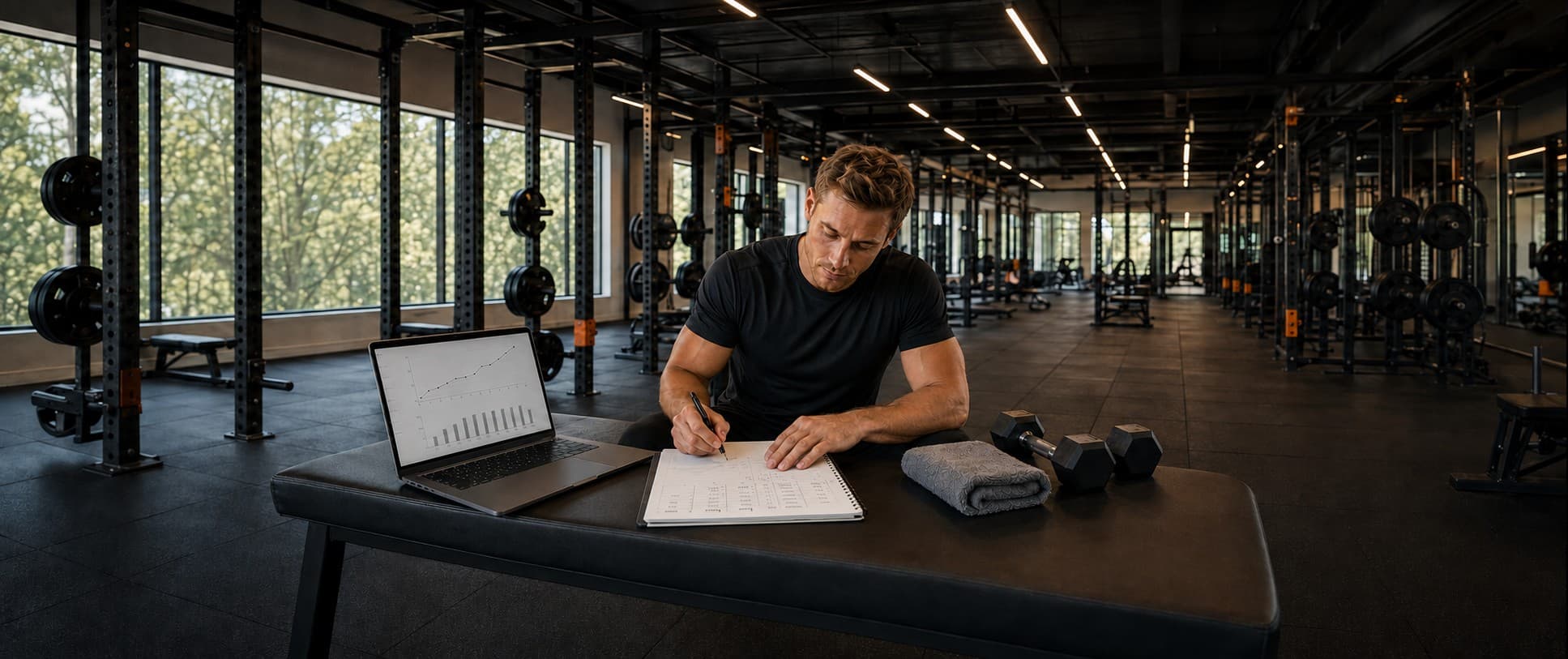
Muscle Building with a Plan: How to Create a Training Programme That Suits You
My Fitness Club